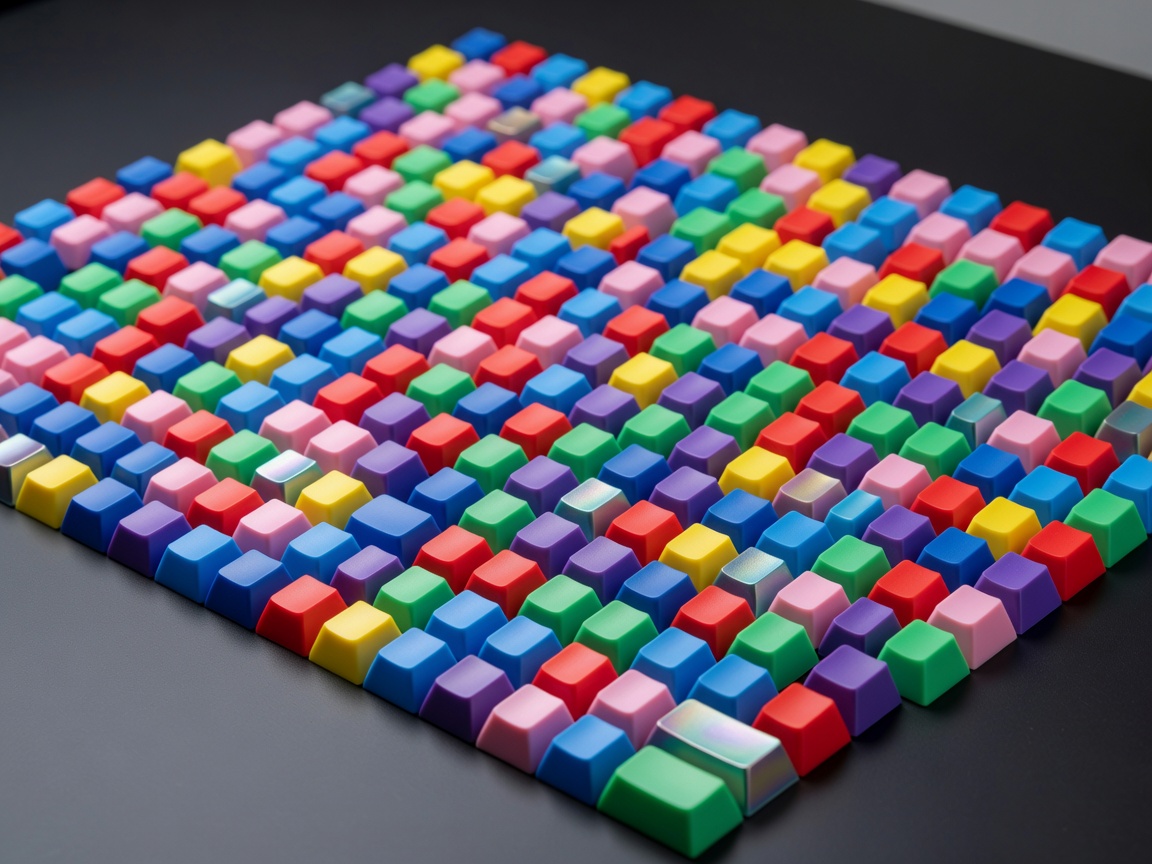
Why Keycaps Matter
If switches are the heartbeat of your mechanical keyboard, the keycaps are the skin. They are the only part of the keyboard that you physically touch during operation. Consequently, keycaps have a profound impact on the typing experience, influencing both the tactile sensation on your fingertips and the acoustic resonance of the switch beneath.
When selecting keycaps for a custom build, enthusiasts must navigate three primary variables: the material from which the keycap is made, the physical shape and contour (known as the profile), and the method used to apply the legends (the letters and symbols).
Material Showdown: ABS vs. PBT
ABS (Acrylonitrile Butadiene Styrene)
ABS is the most common plastic used in mass-market keyboards, but it is also used in high-end, enthusiast-grade custom sets. High-quality ABS is prized for its ability to produce incredibly vibrant, saturated colors that other plastics struggle to achieve. ABS also tends to yield a slightly crisper, higher-pitched acoustic profile.
The primary downside of ABS is its durability against friction and skin oils. Over months of heavy use, the texture on ABS keycaps will wear down, resulting in a glossy, smooth "shine" on frequently pressed keys. While some enthusiasts dislike this shine, others view it as a natural patina of a well-loved board.
PBT (Polybutylene Terephthalate)
PBT is a denser, harder plastic compared to ABS. Its defining characteristic is its resistance to wear and skin oils; PBT keycaps maintain their matte, textured finish for years without developing a glossy shine. Acoustically, PBT is known to produce a deeper, more muted sound, heavily favoring boards attempting to achieve a "thocky" sound signature.
However, PBT is notoriously difficult to manufacture in large, thick molds. The material shrinks as it cools, leading to warped spacebars and longer modifier keys if the manufacturing tolerances are not strictly controlled. Furthermore, PBT cannot be manufactured in colors as vibrant as ABS, often resulting in slightly muted or pastel palettes.
Understanding Keycap Profiles
The profile of a keycap refers to its physical shape and height. Profiles dictate how your fingers traverse the keyboard.
- Cherry Profile: The gold standard in the custom hobby. Cherry profile is a relatively low-height, cylindrical, and sculpted profile (meaning each row has a slightly different angle). It is highly ergonomic and comfortable for long typing sessions without a wrist rest.
- OEM Profile: Similar in shape to Cherry but noticeably taller. This is the profile most commonly found on pre-built gaming keyboards.
- SA Profile: A vintage-inspired, spherical profile that is exceptionally tall. SA keycaps look stunning and produce a deep acoustic resonance due to the large empty space inside the cap, but they almost always require a wrist rest for comfortable typing.
- DSA / XDA Profiles: These are uniform profiles, meaning every row on the keyboard has the exact same height and shape. They offer a clean, minimalist aesthetic and allow for ultimate flexibility in arranging layouts, though they lack the ergonomic sculpting of Cherry.
Manufacturing the Legends
The way letters and numbers are applied to keycaps is crucial for longevity. In cheap keyboards, legends are often pad-printed or laser-etched, which can easily rub off after moderate use. Custom keycaps rely on two superior methods:
Double-Shot Injection
This premium manufacturing method involves molding two separate pieces of plastic. The first piece forms the legend, and the second piece forms the main body of the keycap around it. Because the legend is a physical piece of plastic running entirely through the keycap, it is physically impossible for the legend to ever fade or wear away. Double-shot is commonly used with ABS plastics.
Dye-Sublimation (Dye-Sub)
Dye-sublimation involves using intense heat to impregnate dyes deep into the plastic of the keycap. Like a tattoo for plastic, the legend becomes part of the material itself and will not rub off under normal circumstances. Dye-sub is exclusively used with PBT plastics, as ABS would melt under the required heat. It is excellent for applying highly detailed, multi-colored novelty designs, but the dye must always be darker than the plastic it is printed on.