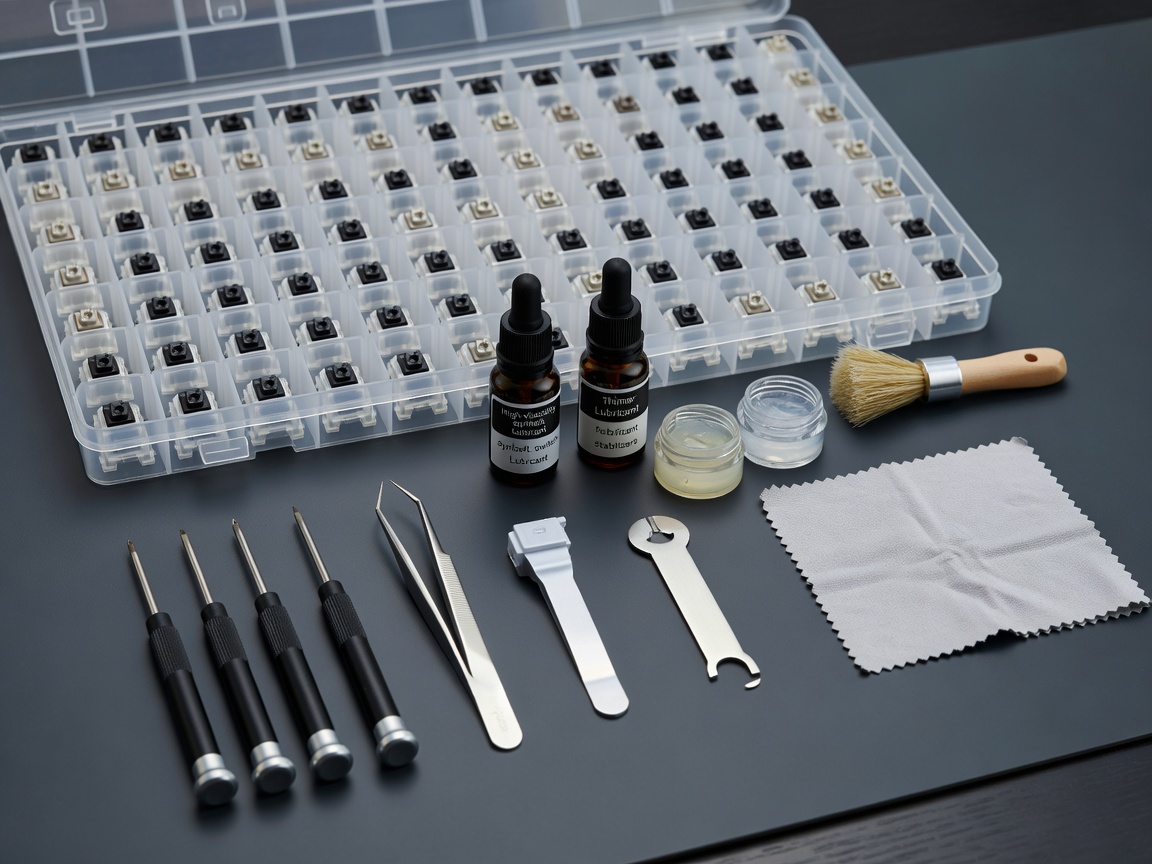
The Pursuit of Perfection
Assembling a custom keyboard is only the first step. "Modding" is where true enthusiasts spend the bulk of their time. Factory-produced components have microscopic imperfections, resulting in scratchy keypresses, rattling stabilizers, and hollow acoustic resonance. Through careful manual intervention, these flaws can be completely eliminated, elevating an average keyboard into a luxury typing instrument.
Switch Lubrication
Lubing your switches is the most time-consuming but most rewarding modification you can perform. It involves opening every individual switch housing and applying a microscopic layer of specialized lubricant to the friction points.
Choosing the Right Lube
Not all lubricants are created equal. Industrial oils or WD-40 will destroy plastics and ruin a keyboard. The hobby relies on high-grade synthetic lubricants, most notably from the Krytox and Tribosys lines.
- Krytox 205g0: A thick, buttery grease. It is the gold standard for linear switches. It completely eliminates plastic-on-plastic scratchiness and significantly deepens the sound signature. It must be applied very sparingly, or the switch will feel sluggish.
- Tribosys 3203: A thinner grease, ideal for tactile switches. Heavy lubes can diminish the tactile bump of a switch; 3203 smooths out the travel while preserving the intended physical feedback.
- Krytox 105: A liquid oil used exclusively for lubricating switch springs. "Bag lubing"—shaking all the springs in a plastic bag with a few drops of 105—completely eliminates annoying spring ping and crunch.
Stabilizer Tuning
Stabilizers sit under large keys (like the Spacebar, Enter, and Backspace) to prevent them from wobbling. Unmodified stabilizers are the single biggest source of annoying rattle in any keyboard. A perfectly tuned spacebar is the hallmark of a skilled builder.
The Holee Mod
A technique designed to silence the wire rattling inside the stabilizer housing. It involves placing a tiny, cut strip of medical tape (or a band-aid) inside the housing's stem hole. This creates a soft cushion for the wire to hit against, completely eliminating metal-on-plastic ticking sounds.
Lubing Stabilizers
Unlike switch stems, the metal wires of a stabilizer require thick, heavy damping. Enthusiasts typically use dielectric grease or specialized products like XHT-BDZ to heavily coat the ends of the wire. This thick layer prevents the wire from rattling within the plastic housing.
Acoustic Modifications
If your keyboard case sounds hollow, pingy, or simply lacks character, several simple acoustic mods can drastically alter the sound profile.
The Tempest Tape Mod
Discovered by an enthusiast named Tempest, this mod involves applying multiple layers of common masking tape (painter's tape) directly to the back of the PCB. The tape acts as an acoustic filter, reflecting certain sound frequencies back up through the switches while absorbing harsh, high-pitched pings. The result is a louder, deeply satisfying "poppy" sound signature.
PE Foam Mod
By placing a very thin sheet of packing foam (Polyethylene foam) between the PCB and the switches, builders can achieve a distinct, marbled sound profile. The foam heavily dampens the switch bottom-out impact and compresses the sound frequencies into a highly sought-after "creamy" acoustic tone.